How to Draw a Sailboat on the Water in Five Easy Steps
Sketch a small sailboat in five steps: a shallow hull, a vertical mast, two sails, a tiny flag and a waterline with waves and a broken reflection, plus a simple horizon.
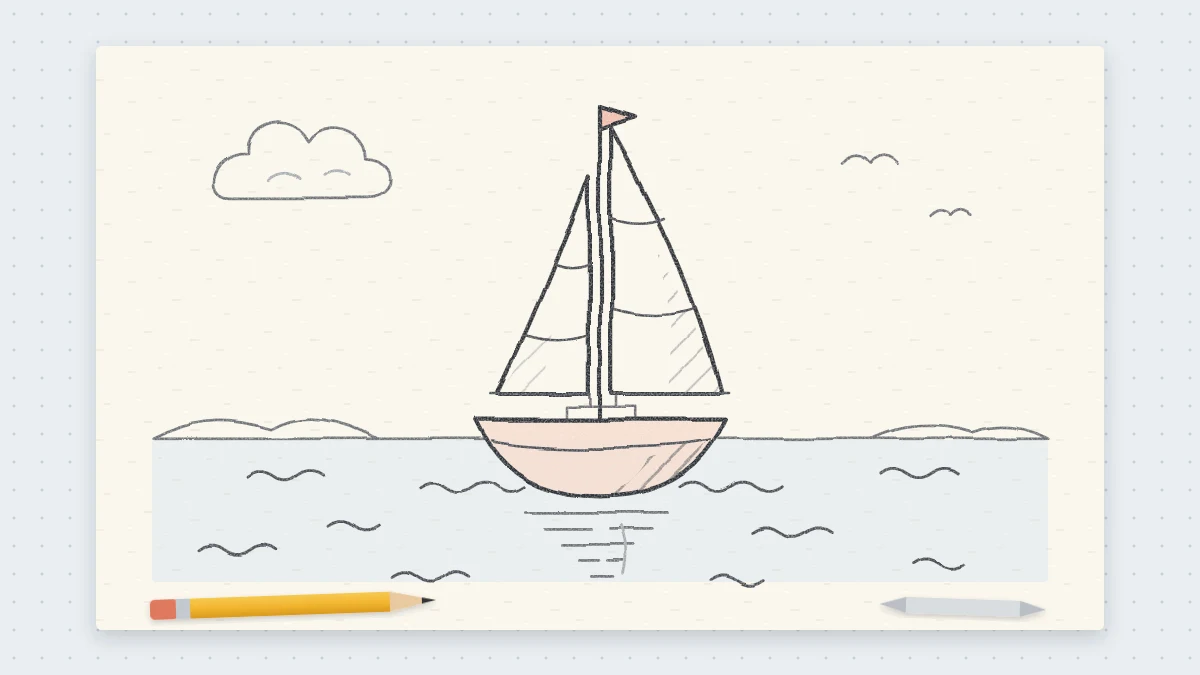
This drawing at a glance
What you need
- HB pencil
- 2B pencil
- Soft eraser
- Plain paper
A sailboat is a rare subject that looks pleasing almost as soon as you start. One curve, one straight line and two triangles are enough to be recognizable, and a few strokes of water turn the sketch into a small scene.
This lesson on how to draw a sailboat builds the boat in five steps, then adds a waterline, a reflection and a low horizon. If you have practiced simple triangles and curves, you already know every shape involved.
Before you start
Use an HB pencil for the light first lines and a 2B for the final outline and the water. Any plain paper works.
Plan the page before you draw. The sails are much taller than the hull, so place the hull in the lower third of your drawing area and leave plenty of room above it. Decide now which end of the boat is the front, so the two sails end up on the correct sides of the mast.
Draw the sailboat in five steps
- Hull. Lightly draw a nearly straight line about 4 in (10 cm) long for the deck, dipping very slightly in the middle. Beneath it, draw one shallow curve that joins both ends, like a thin slice of melon. At its deepest, the hull should be only about one-fifth as tall as it is long. Let the front end come to a gentle point.
- Mast. From the deck, a little forward of the middle, draw a straight vertical line upward. Make it slightly taller than the hull is long, about 4 1/2 in (11 cm).
- Sails. Behind the mast, draw a large triangle for the mainsail. One side runs along the mast from just above the deck to just below the top. The bottom edge reaches back almost to the rear of the hull, and the third side joins the two. In front of the mast, draw a smaller, narrower triangle from about three-quarters of the way up the mast down to the front tip of the hull.
- Flag. At the very top of the mast, add a tiny triangle flag pointing toward the back of the boat. Keep it small, no longer than the width of your fingertip.
- Water. Draw a waterline on both sides of the hull, crossing just below its widest part so the bottom of the curve sits under the surface. Add a few short, shallow wave marks nearby. Directly under the hull, draw a broken reflection: four or five short horizontal dashes that get shorter as they go down. Finish by going over the boat with the 2B pencil.
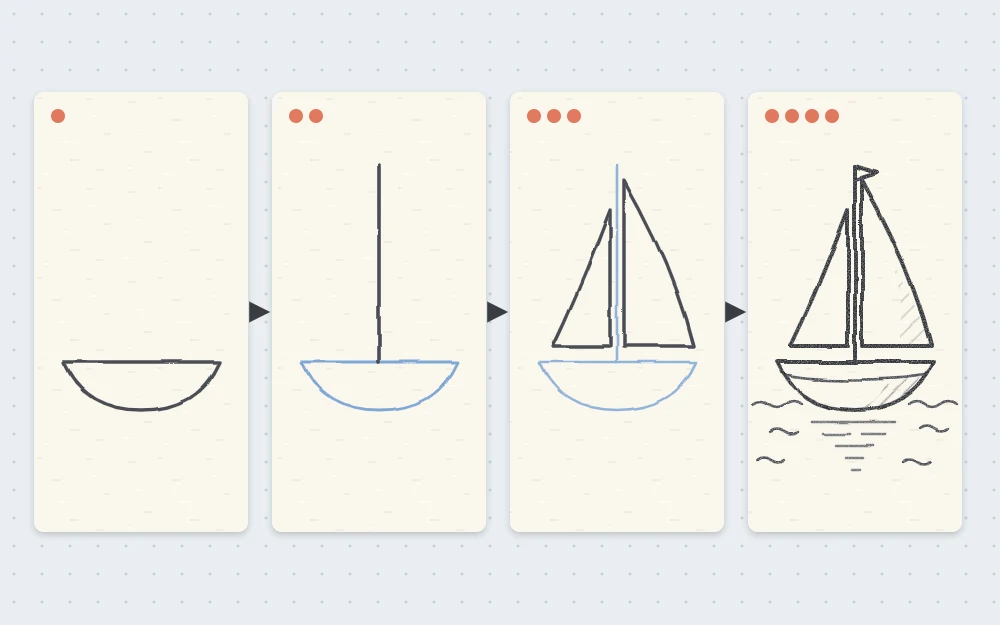
Proportion check: the mast is about as tall as the hull is long, and the mainsail is roughly twice as wide as the front sail. If the boat looks heavy, the hull is probably too deep.
Keep the mast vertical
The mast is the backbone of the drawing. If it leans, the whole boat seems to tip over. Compare it with the side edge of your paper: the two should be parallel.
It helps to mark a dot where the mast begins on the deck and another directly above it for the top, then join them in one stroke. Turn the page a quarter turn to check. A lean that hides when the drawing is upright is easy to spot sideways.
Tip
A slight lean can be a choice. Tilt the mast and the whole hull together by the same small angle, and the boat appears to be heeling in a breeze. Tilt only the mast, and it simply looks wrong.
Curve the sails so they catch the wind
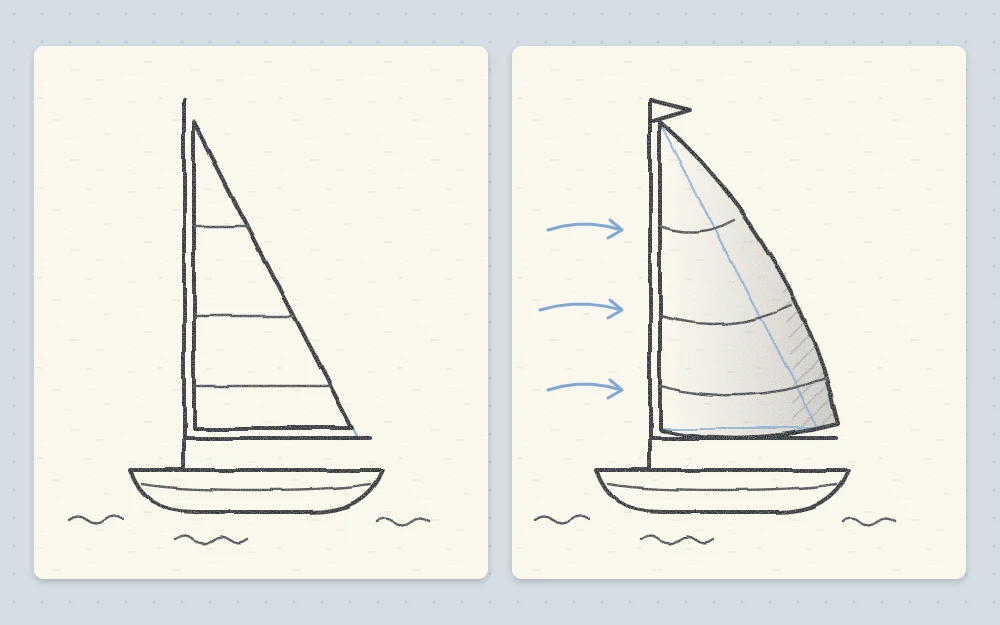
Straight-edged triangles look like stiff paper flags. Real sails are cloth, and wind pushes them into a soft curve. To show that, redraw two edges of each sail:
- Bow the long outer edge outward, away from the mast, in one gentle arc.
- Let the bottom edge sag very slightly downward in the middle.
- Keep the edge along the mast straight, because it is attached there.
The curves should be subtle. At the widest point, the bulge only needs to be about the width of a pencil away from the original straight line.
Add a horizon and a sky
A little scenery gives the boat somewhere to be.
- Horizon. Draw a light, level line across the page behind the boat, somewhere between the deck and the lower third of the sails. Stop the line where it meets the hull and sails so it does not cut through them.
- Distant waves. Make the wave marks shorter, fainter and closer together as they approach the horizon. This suggests distance.
- Cloud. One small cloud near the horizon is enough. The guide to soft, fluffy clouds shows how to build one from overlapping circles.
- Bird. A far-off bird is only a shallow curved V. Keep it smaller than the flag.
Keep everything in the background lighter than the boat. Use the HB pencil and gentle pressure so the sailboat stays the darkest, clearest thing on the page.
Troubleshooting
- The boat sits on top of the water like a toy on a table. The waterline is touching the very bottom of the hull. Raise it so a sliver of the hull is below the surface.
- The reflection looks like a second boat. It is too solid. Break it into separate dashes with gaps of white paper between them.
- The waves look like a row of identical bumps. Vary their length and spacing, and leave some areas of water empty.
- The sails look too small. Check the mast against the hull. It should be at least as tall as the hull is long.
Easy variations
Change one thing at a time and you get a different boat. Add two or three horizontal seams across the mainsail. Draw a small cabin as a low rectangle on the deck, or a thin stripe along the hull. Shade one sail lightly to suggest that the sun is on the other.
For a fuller scene, draw a second, much smaller sailboat near the horizon, or look below the surface and add a simple side-view fish under the waves.
Early attempts often have a leaning mast or lopsided sails. Sketch the boat again at half the size, and the shapes usually settle into place a little more each time.
Frequently asked questions
How do I draw water around a boat without overdoing it?
Use fewer marks than you think you need. A waterline on each side of the hull, five or six short wave strokes of different lengths and a broken reflection are enough. Leaving most of the water as blank paper makes it look calm and bright.
Which sail goes in front of the mast?
The smaller one. On a simple two-sail boat, the large mainsail is attached along the back of the mast and reaches toward the rear of the hull. The smaller front sail runs from high on the mast down to the front tip of the boat.
Why does my sailboat look like it is tipping over?
The mast is probably leaning while the hull is level. Check the mast against the side edge of your paper and redraw it parallel. If you want the boat to lean on purpose, tilt the hull and mast together by the same small angle.