How to Draw Buildings: Simple Shapes for Shops, Barns and Towers
Every building starts as a box with a roof shape on top. Follow simple pencil steps for a shop front, a barn and a lighthouse, then line them up along one ground line as a small street.
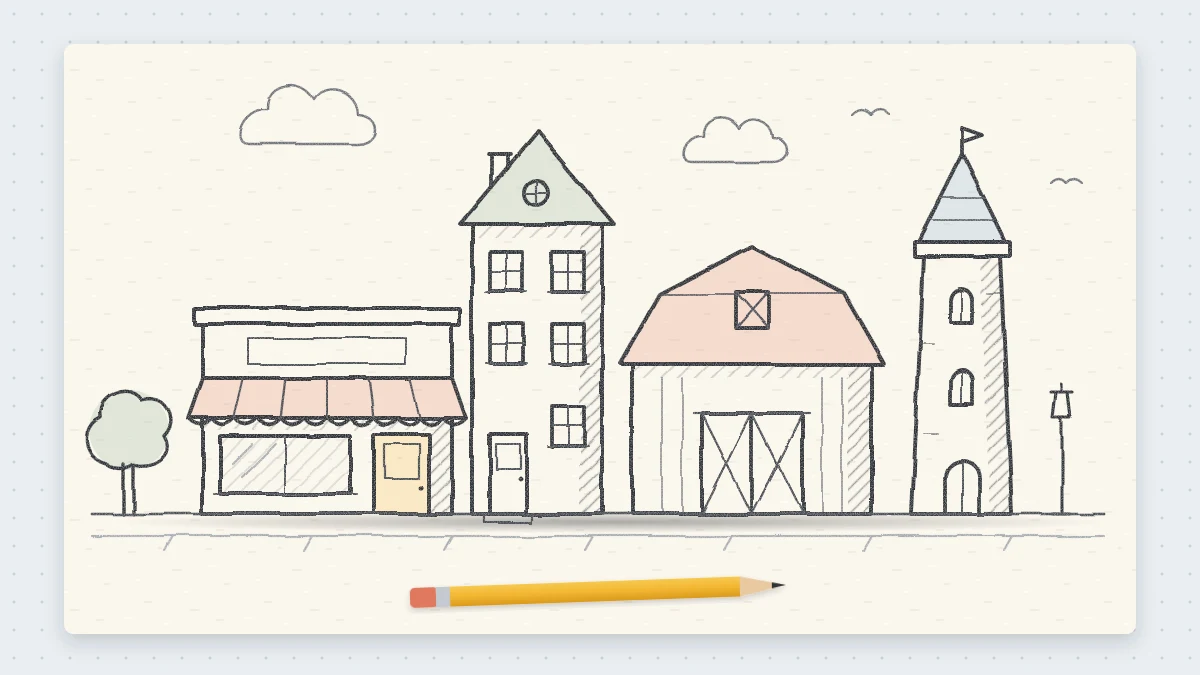
This drawing at a glance
What you need
- HB pencil
- 2B pencil
- Soft eraser
- Plain paper
- Ruler (optional)
Once you can sketch a simple cottage, most other buildings are closer than they look. A shop, a barn and a lighthouse seem very different, yet each one is a plain box with a different lid on top.
This guide on how to draw buildings works through those three examples with a pencil and plain paper, then lines them up into a small street. If you have not drawn a basic cottage yet, begin with the step-by-step house tutorial and come back; everything here grows from that square and triangle.
Start With a Box and a Roof Shape
Look at any building front and ignore the details. What remains is a rectangle for the walls and one shape for the roof: a flat strip, a steep triangle, a triangle with a bend in each slope, or a small pointed cap. Change the width of the rectangle, swap the roof, and you have a different building.
Draw these first shapes as light construction lines with an HB pencil, barely pressing, so they erase cleanly later. Keep every vertical edge parallel to the side of your paper. Leaning walls are the most common reason a building looks wrong.

Draw a Shop Front
A shop is wider than it is tall. Make yours about 4 in (10 cm) wide so there is room for the window.
- Draw a wide rectangle, roughly one and a half times as wide as it is tall. Add a thin flat strip along the top edge, slightly wider than the walls, for the roof line.
- About a third of the way down the wall, draw the awning: a long, shallow shape as wide as the wall at the top and a little wider at the bottom. Finish its lower edge with a row of small scallops and divide it with evenly spaced stripes.
- Stand a door on the bottom edge at one side, reaching up to the awning. Fill most of the remaining wall with one big window, leaving a low strip of wall beneath it.
- Add a small pane and a dot handle to the door, and a plain blank band above the awning where a sign would hang.
Draw a Barn
A barn is taller, and its roof has a broken pitch: each slope starts steep at the walls, then bends to a gentler angle near the top.
- Draw a rectangle a little taller than it is wide.
- Mark a light dot above the center of the top edge, about half the wall height up. This is the peak of the roof.
- From each top corner, draw a short steep line rising and leaning slightly inward until it is halfway up to the peak. From there, draw a shallower line to the dot. Check that both sides bend at the same height.
- Center a pair of large double doors on the bottom edge, about half as wide as the wall, with a vertical line down the middle and one diagonal brace on each door. Add a small square loft opening under the peak.
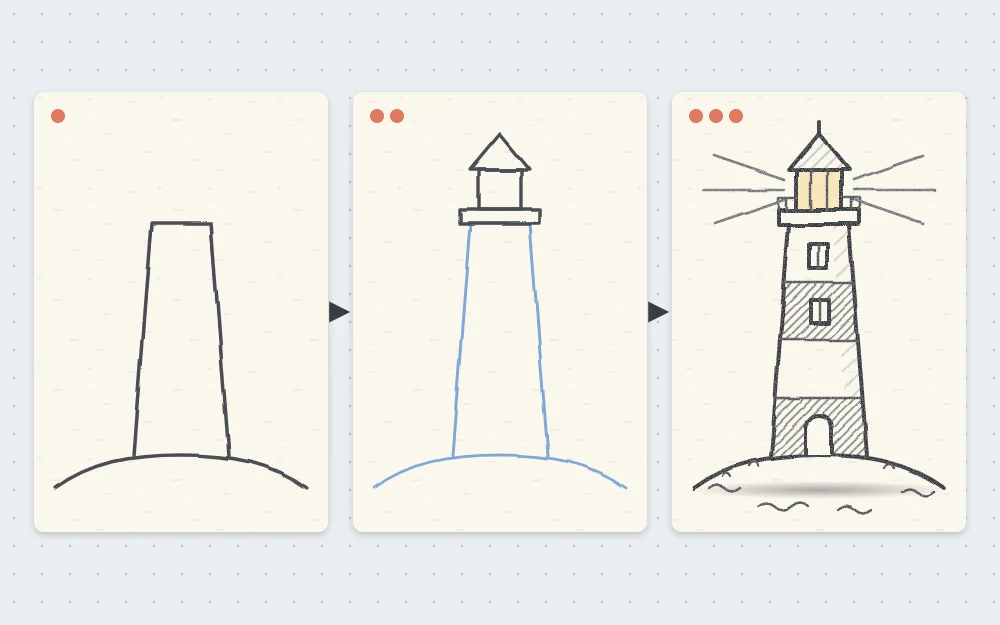
Draw a Lighthouse in Six Steps
The lighthouse is a tapered box: wide at the bottom, narrow at the top. One proportion check keeps it elegant: the tower is about four times as tall as its base is wide, and the top is about half the width of the base.
- Mound. Near the bottom of the page, draw a low curve like the top of a hill, about 2 in (5 cm) wide.
- Tower. Draw a faint vertical center line rising from the middle of the mound. Mark the base width, about a third of the mound, and a top width half as wide. Join the marks with two straight, slanted sides.
- Gallery. Across the top of the tower, draw a narrow horizontal band that sticks out a little past both sides.
- Lantern room and cap. Sit a small, nearly square rectangle on the gallery, about as wide as the tower top. Top it with a pointed triangle cap that is slightly wider than the lantern room.
- Door and windows. Draw a small arched door on the center line where the tower meets the mound, then two small windows above it, one higher than the other.
- Stripes and rays. Add three or four evenly spaced horizontal stripes across the tower and a few short straight lines fanning out from both sides of the lantern room. Go over the outline with a 2B pencil and erase the center line.
Line Buildings Up as a Small Street
Draw one long, light ground line across the page and stand every building on it. Then vary two things: height and width. Four boxes of the same size read as a fence, not a street.
Let neighbors share a wall or leave a narrow gap. Before adding details, compare each height with the one beside it; the habit of measuring proportions by eye makes this quick.
When flat fronts feel comfortable, give the building at the end of the row a receding side wall. The method is the same one used to turn a square into a cube.
Details That Suggest Scale
A viewer judges the size of a building from the things people use.
- Doors. Keep every door on the street about the same height. A tall building then looks tall because its door is small against the wall.
- Windows. One row of windows per floor, lined up on a light horizontal guideline.
- Steps. Two or three thin stacked rectangles under a door, each slightly wider than the one above.
- A lamp post. A thin vertical line a little taller than a door, with a small box lantern on top.
Common mistake
Scaling the door up with the building. A tower with a giant door looks like a small toy, so keep doors person-sized everywhere.
Troubleshooting and What to Try Next
- Walls lean. Rotate the paper so vertical lines are drawn toward you, and check them against the paper edge.
- The barn roof looks lopsided. Draw a faint horizontal line through both bends; they should sit on it.
- The street looks flat. Use a heavier line weight on the ground line and on the nearest outlines, and keep window panes lighter.
From here, try a narrow house with a steep gable or a row of shops with different awnings. First streets are usually a little crooked.
Frequently asked questions
Do I need a ruler to draw buildings?
No. A ruler is handy for a long ground line, but freehand walls give a sketch more character and train your hand at the same time. Draw each wall as one light stroke, compare it with the edge of the paper, and correct it before pressing harder with a softer pencil.
How do I make buildings look three-dimensional?
Start by adding a side wall to one flat front: draw short slanted lines back from the top and bottom corners, close them with a vertical line, and shade that wall lightly. Overlapping one building slightly in front of another also adds depth without any perspective rules.
Why do my buildings look like they are leaning?
Usually the vertical edges drift as the hand moves down the page. Turn the paper so each wall is drawn toward your body, keep comparing walls with the paper edge, and sketch them faintly first. Fixing a light line takes a second; fixing a dark one leaves a mark.