Easy Things to Draw: 25 Simple Ideas for Beginners
Twenty-five simple subjects to sketch right now, grouped by where you will find them, with the basic shapes behind each one and tips for choosing by difficulty.
The hardest part of a sketching session is often the first thirty seconds, when the page is blank and nothing seems worth drawing. A short list solves that. Pick one subject, draw it small, and move on to the next.
Below are 25 easy things to draw, grouped by where you are likely to find them, with the basic shapes behind each one. None needs special skill, only light construction lines and a willingness to let the first attempt be uneven.
How to choose from the list
Not every subject here is equally simple. A rough guide:
- Easiest: subjects made of one or two flat shapes, such as an egg, a leaf, a cloud or a key.
- A little harder: subjects with ellipses or stacked forms, such as a mug, a jar or a lighthouse.
- Harder still: living things, where proportion matters more, such as a bird or a cat.
Start with whichever group feels comfortable and draw each subject about 2 in (5 cm) tall. Small sketches take only a few minutes each, so a mistake costs very little.
On the desk
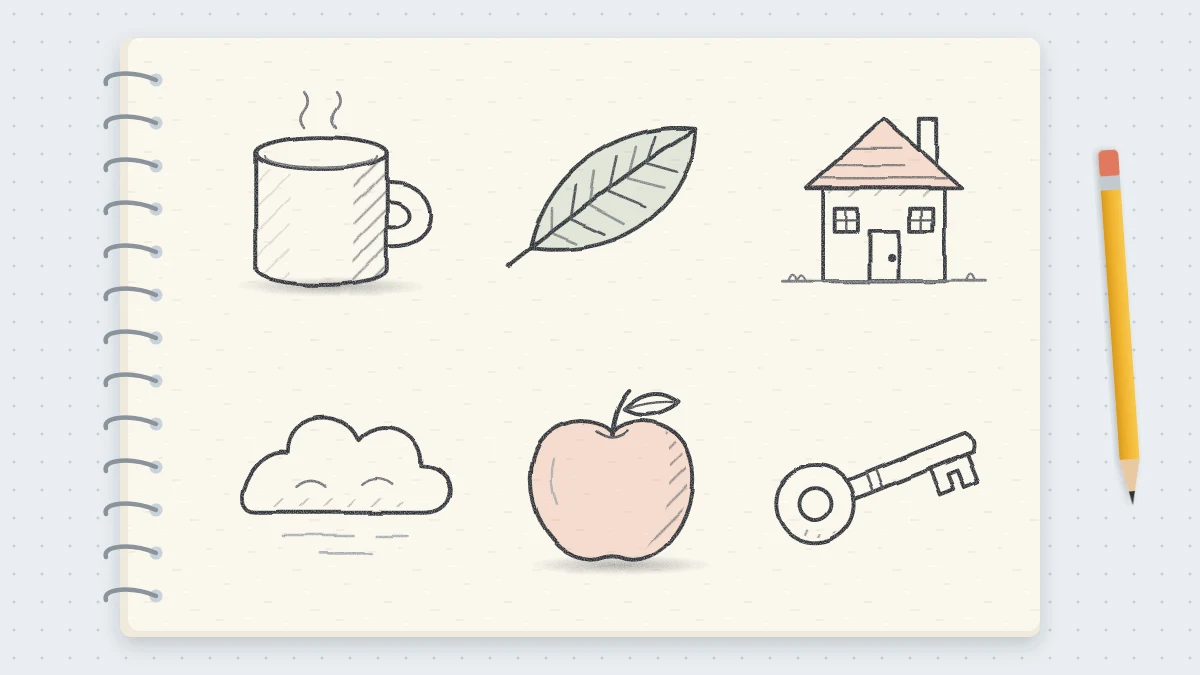
- Mug. A cylinder with an ellipse for the rim and a C-shaped handle. The tutorial on drawing a mug with a believable rim covers the tricky part.
- Key. A circle or oval for the head, a long thin rectangle for the shaft and a few small notches at the end.
- Book. A flat box. Draw a slanted rectangle for the cover, then add a thin edge for the pages.
- Scissors. Two long narrow triangles crossing at a small circle, with two oval loops for the handles.
- Pencil. A long thin rectangle with a small cone at one end and a short band near the other.
In the kitchen
- Apple. A slightly squashed circle with a small dip at the top and a short stem.
- Pear. A small circle sitting on a larger one, joined by two smooth curves.
- Spoon. An oval bowl and a long handle that widens slightly toward the end.
- Jar. A tall cylinder with a shorter, slightly wider cylinder on top for the lid.
- Egg. An oval that is a little narrower at one end. It is a fine subject for a first try at shading.
Outside
- Tree. A trunk that widens at the base and a loose cloud shape for the crown. When you want more than a lollipop shape, try the full guide to a tree with branches and a leafy crown.
- Cloud. A flat base line with a bumpy top made from overlapping circles of different sizes.
- Leaf. A curved center line with a pointed oval around it and a few side veins.
- Mountain. An uneven zigzag line, with a second line dropping from each peak to divide light from shadow.
- Bird. A tilted egg for the body, a small circle for the head, a triangle beak and a wedge tail.

Simple buildings
- House. A square with a triangle on top, then a door and two windows. The step-by-step lesson on drawing a tidy cottage adds a chimney, a path and a bush.
- Lighthouse. A tall tower that narrows toward the top, with a small box for the lamp room and a pointed cap.
- Barn. A wide rectangle with a roof that bends partway up each side, plus large double doors.
Friendly extras
- Cat. A circle head on a pear-shaped body, with two triangle ears and a curled tail. Follow the sitting cat tutorial for the face.
- Fish. A pointed oval like a lemon, a triangle tail and a small fin on top.
- Cupcake. A cut-off cone for the paper case, with three shrinking rounded tiers of frosting above it.
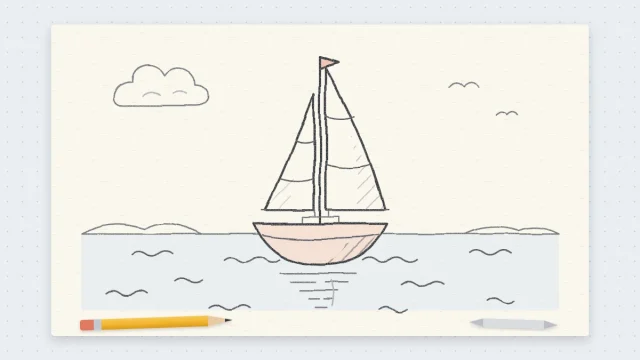
- Sailboat. A shallow curved hull, a vertical mast and two triangles for sails.
- Cactus. A tall rounded column in a tapered pot, with two arms that bend upward.
- Snowman. Three stacked circles that get smaller toward the top, plus a hat and twig arms.
- Pumpkin. A wide flattened oval divided by curved lines that bow outward, with a thick stem.
Why real objects teach more than copying
Copying another drawing can be enjoyable, but someone else has already done the hard part: turning a solid object into flat lines. When you draw the actual mug on your desk, you make those decisions yourself. You judge how wide the rim looks from where you sit, where the handle attaches and which side is darker.
That is the skill that carries over to every later subject. So wherever you can, put the real thing in front of you. Half the list above is probably within reach right now.
Tip
Before you draw a subject, name its shapes out loud or in your head: “cylinder, ellipse, C-shape.” If you can name them, you can draw them.
Getting more from each sketch
- Start light. Sketch the big shapes with an HB pencil and barely any pressure. Go over the lines you want to keep with a 2B.
- Draw it twice. A second attempt, right beside the first, is nearly always better, because you have already solved the main problems.
- Change the view. Turn the object, or look at it from a little higher, and draw it again.
- Fill a page. Six small sketches on one sheet feel less precious than one large drawing, and they give you more practice in the same time.
When a sketch does not work
If a drawing goes wrong, it is rarely the details. Look at the largest shape first: is it too wide, too tall or tilted? Fix that with a light correction line, and the rest often falls into place.
Keep the page either way. A sketchbook full of wobbly mugs and lopsided pears is a record of practice, and looking back over it is one of the best ways to see how your eye is changing.
Frequently asked questions
What is the easiest thing to draw as a complete beginner?
Subjects made from one or two flat shapes are the gentlest start: an egg, a leaf, a cloud or a key. They have no ellipses and no tricky proportions, so you can concentrate on drawing a light, smooth outline before moving on to mugs, jars and animals.
How long should I spend on each sketch?
For small practice sketches, roughly three to five minutes each is plenty. The aim is to capture the main shapes, not to finish every detail. Several quick drawings of different subjects usually teach more than a single careful one, especially in the early weeks.
Is it better to draw from real objects or from pictures?
Both are useful, but a real object teaches more. You have to work out the shapes, angles and proportions yourself, and you can turn the object to understand it. Pictures are handy for subjects you cannot bring to your desk, such as a mountain or a lighthouse.