How to Draw a Fish: An Easy Tutorial With Scales and Fins
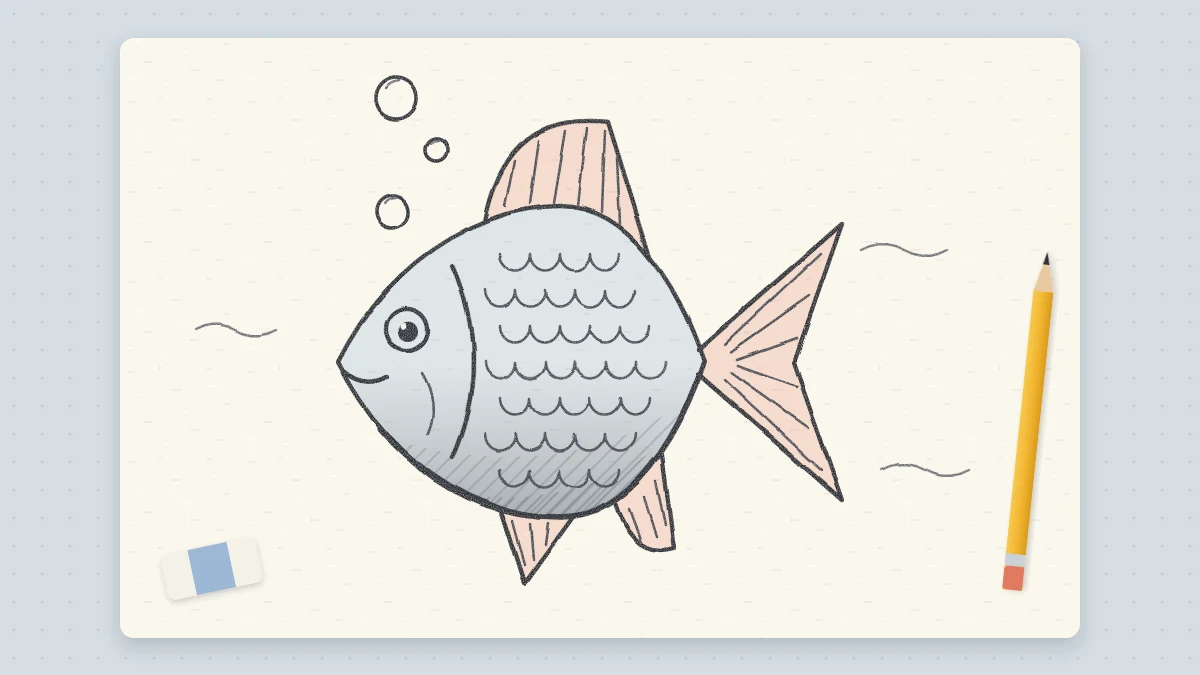
Draw a side-view fish in five steps: a lemon-shaped body, a notched tail, three fins, a gill line with eye and mouth, then rows of scales. Change the body shape for long, round or tall fish.
This drawing at a glance
What you need
- HB pencil
- 2B pencil
- Soft eraser
- Plain paper
If you want an animal that is hard to get badly wrong, pick a fish. It has no legs, no neck and no tricky pose: one body shape, a tail and a few fins, all seen flat from the side.
This tutorial covers how to draw a fish in five steps, from a lemon-shaped body to rows of scales and fine fin lines. It then shows how changing that first shape gives you a whole school of different fish.
What You Need
An HB pencil for light construction lines, a 2B pencil for the final outline and the scales, a soft eraser and plain paper turned sideways. The body starts as an oval, so if yours tend to wobble, spend a few minutes on circles and ovals drawn with the whole arm before you begin.
Draw the Fish in Five Steps
The fish faces left. Proportion check: the body is about twice as long as it is tall, and the tail adds roughly a third of the body length again.
- Body. Draw a pointed oval about 4 in (10 cm) long, shaped like a lemon lying on its side. Both ends come to a soft point, and the tallest part sits a little in front of the middle.
- Tail. At the right-hand point, add a triangle that spreads away from the body, with its narrow end joined to the body. Cut a V-shaped notch into its far edge so it becomes two lobes. The tail is about as tall as the body.
- Fins. Draw a top fin along the back, starting just behind the highest point: a low shape that rises quickly at the front and slopes away toward the tail. Add two small lower fins under the belly, one below the middle of the body and one closer to the tail, each a small triangle with rounded corners leaning backward.
- Gill, eye and mouth. About a quarter of the way along the body from the nose, draw a curved gill line from near the top to near the bottom, bowing toward the tail like a closing parenthesis. In front of it, place a round eye slightly above the middle, with a smaller dark pupil and a tiny white highlight. Add a short curved mouth at the front point.
- Scales and fin rays. Behind the gill line, fill the body with rows of small U shapes opening toward the head, each row offset so every U sits between two in the row before. Then draw fine, slightly spreading lines in the fins and tail. Darken the outline with the 2B pencil and erase any construction lines.

Scales Without the Tedium
Scales look complicated and are really a repeated mark. A few habits keep them tidy.
- Start the first row right behind the gill line and work toward the tail.
- Let each row follow the curve of the gill line, so the pattern wraps around the body.
- Make the scales a little smaller as they approach the tail, where the body narrows.
- Keep the head, in front of the gill line, completely smooth.
You do not have to fill every row. Drawing scales clearly along the back and middle, then letting them fade into a few scattered marks near the belly, leaves a pale underside that suggests light and makes the fish look rounder.
Tip
Draw the scales with a lighter touch than the outline. If both have the same line weight, the pattern overpowers the shape of the fish.
Change the Body Shape
Almost all the variety in fish comes from the first shape. Keep the tail, fins and face the same, swap the base, and compare the results.
| Base shape | Proportion | What to adjust |
|---|---|---|
| Long thin oval | About four times as long as tall | A long low top fin and a deeply notched tail |
| Nearly round circle | About as tall as it is long | Small fins, a short fan tail and a larger eye |
| Tall diamond | Taller than it is long | Pointed fins sweeping back from the top and bottom corners |
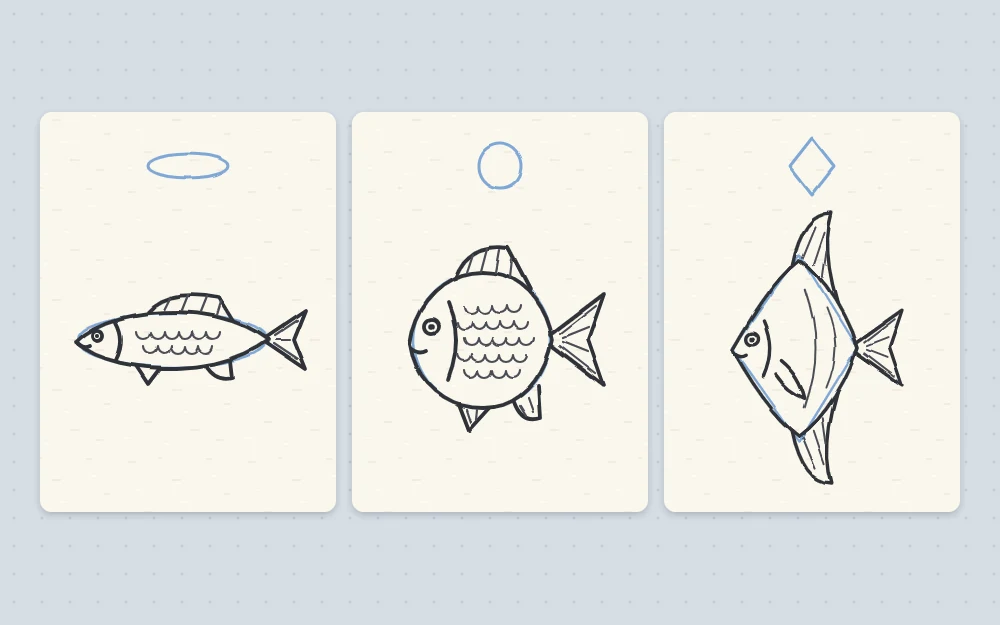
You can also change the markings. Swap the scales for three or four vertical stripes that curve with the body, or for a scattering of small spots along the back.
Build a Small Underwater Scene
A single fish in the middle of a blank page can look like a diagram. A few simple additions give it somewhere to swim.
- Bubbles. Three small circles rising from the mouth, each a little larger than the one below and slightly off to one side. Leave a tiny curved highlight inside each.
- Water plants. Tall wavy ribbons rising from the bottom edge, each drawn as two lines that wander together and meet in a point. Lean them all the same way, as if a current is pushing them, and let one pass behind the tail.
- Sea floor. A low, uneven line near the bottom with a few oval pebbles resting on it.
- Company. Two or three much smaller fish in the distance, drawn lightly and without scales.
Fish also turn up at the surface. A small one leaping beside the hull adds life to a sailboat on the water.
Troubleshooting
- The fish looks like a football. The ends are too blunt or too even. Sharpen the tail end and move the tallest point forward.
- The tail looks glued on. Its narrow end is too wide. Pinch the body in slightly where the tail begins.
- The scales look like a net. The rows are lined up one above another. Offset each row by half a scale.
- The eye looks blank. Darken the pupil with the 2B pencil and keep the highlight clean.
What to Try Next
Draw the same fish facing right, then tilt the body upward or downward so it seems to be rising or diving. For another creature built on one tilted body shape, try the perched songbird tutorial. Early fish tend to be uneven, and a full page of quick ones is good practice.
Frequently asked questions
Is a fish a good first animal to draw?
Yes, it is one of the simplest. A side-view fish has no legs, neck or complicated pose, so the whole drawing depends on one body shape plus a tail and fins. Small errors in the outline still read as a fish, which makes it an encouraging subject to begin with.
How do I draw fish scales neatly?
Work in rows from the gill line toward the tail, using small U shapes that open toward the head. Offset every row by half a scale so each mark sits between two in the previous row, and curve the rows to match the gill line. Press more lightly than you did for the outline.
Do I have to draw every scale?
No. Clear scales along the back and middle with only a few scattered marks near the belly often look better than a fully covered body. The pale underside suggests light falling on a rounded form, and the drawing takes less time and looks less busy.