How to Draw a Dog: An Easy Side-View Puppy Step by Step
Sketch a standing puppy in side view in six steps, from a circle head and a bean-shaped body to tube legs, a floppy ear and a collar, with a simple check that keeps the body the right length.
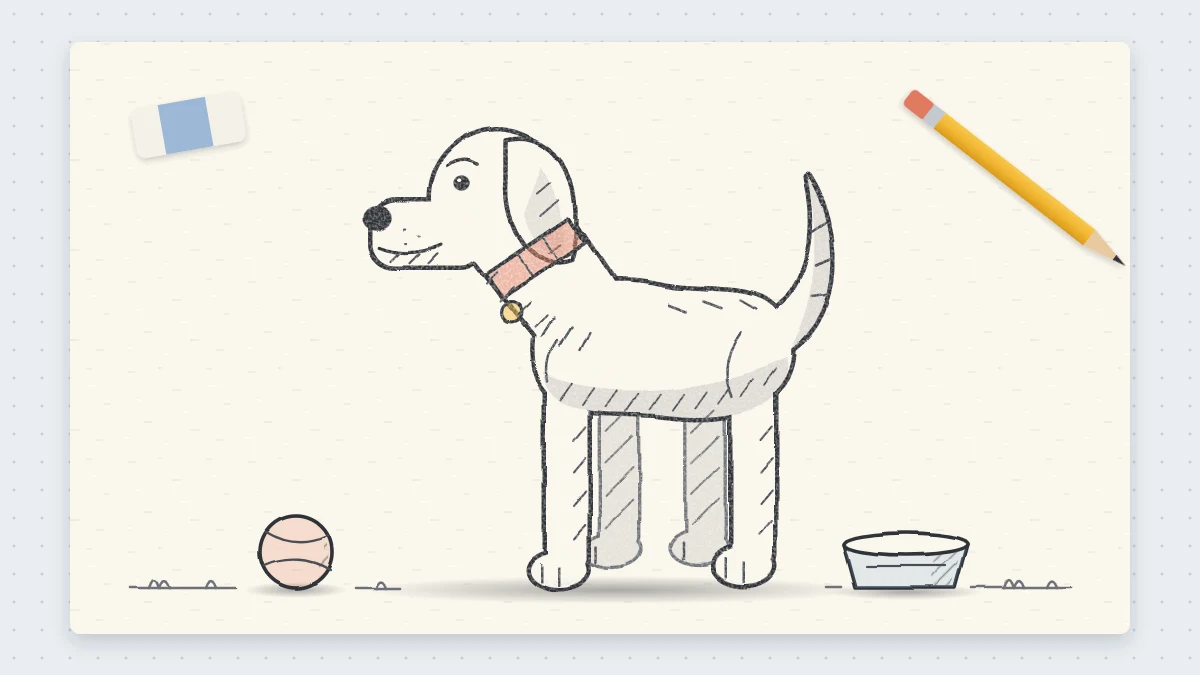
This drawing at a glance
What you need
- HB pencil
- 2B pencil
- Soft eraser
- Plain paper
Dogs trip up many beginners at the same place: the legs. Four of them have to stand on the same ground, and the body between them has to be the right length. Seen from the side, though, a standing puppy breaks down into a circle, a bean and a few tubes.
This lesson on how to draw a dog takes that side view in six steps, with one proportion check to keep the body from stretching. If you have already sketched the sitting cat from two simple shapes, the method will feel familiar.
What You Need
An HB pencil for light construction lines, a 2B pencil for the final outline, a soft eraser and plain paper turned sideways. Keep the first shapes faint so they erase cleanly once the outline is in place.
One Proportion Check Before You Start
The body is about two head-lengths long. Measure the width of the head circle with your pencil tip and thumb, then step that distance along the body twice. If the bean is much longer, the dog turns into a sausage; if it is shorter, it looks cramped. The guide to measuring proportions with a pencil explains this comparing habit in detail.
Two more comparisons help. The legs are about as long as the body is deep, and the head sits higher than the back, not level with it.
Draw the Dog in Six Steps
The dog faces left. Start in the upper left of the page and leave room on the right for the tail.
- Head. Draw a circle about 1.25 in (3 cm) across.
- Body. To the right of the head and a little lower, draw a long bean shape lying on its side: rounded at both ends, with a slight dip along the top for the back. Leave a gap of about half a head between the circle and the bean, and make the bean two head-lengths long.
- Muzzle and neck. On the lower left of the head, add a rounded box for the muzzle, about half as tall as the head and sticking out about half a head-width. Then join head and body with two short lines: one from the back of the head to the top of the bean, one from under the jaw to the chest.
- Legs. Draw four simple tubes, each a pair of nearly parallel lines. Place one near leg under the chest and one under the hips. Draw the two far legs just behind them, slightly shorter and with a lighter line, so they look farther away. All four should end on the same faint ground line.
- Ear, tail and paws. Hang a floppy ear from the top back of the head: a soft, rounded triangle that reaches about level with the mouth. Add a raised tail curving up from the end of the body, thicker at the base and tapering to a point. Finish each leg with a small rounded paw that pushes forward a little. Refine the whole outline.
- Face, collar and fur. Place a small round eye in the front half of the head circle, a rounded nose on the tip of the muzzle and a short mouth line beneath it. Draw a collar as a narrow curved band around the neck. Go over the final lines with the 2B pencil, erase the construction lines and add a few short fur marks on the chest and tail.

Getting the Legs Right
Legs go wrong when they are drawn as four identical posts spaced evenly along the belly. A dog stands on two pairs: front legs under the chest, back legs under the hips, with clear belly showing between the pairs.
- Give each front leg a nearly straight tube that narrows slightly toward the paw.
- Give each back leg a gentle bend: it leaves the hip leaning forward, then angles back a little below the middle before dropping to the paw.
- Overlap each far leg with its near partner, so only part of it shows.
- Look at the negative space under the belly. It should be a wide, low arch, not a narrow slot.
Common mistake
Drawing all four legs with the same dark line. Keep the far pair lighter and a touch shorter, and the dog gains depth straight away.
Change the Ear, Tail and Muzzle
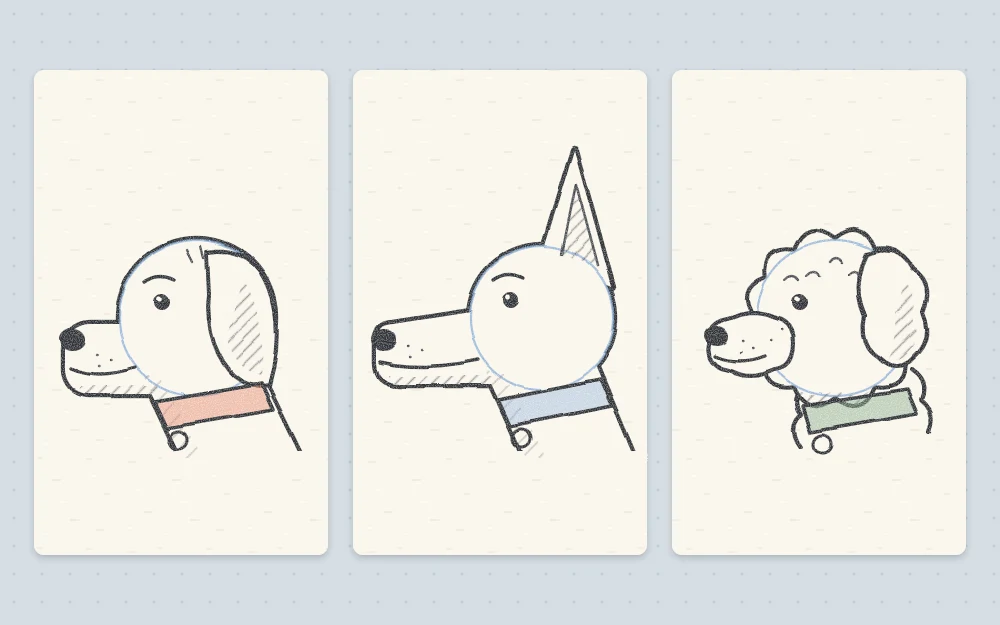
The same circle and bean can suggest many kinds of dog. Change only one or two features at a time and see how much the character shifts.
- Ears. A pointed upright triangle gives an alert look; a long hanging ear looks gentle.
- Muzzle. A short box reads as a puppy. A longer, narrower one reads as an older, leaner dog.
- Tail. Try a tight curl over the back, a long low sweep or a short stub.
- Coat. Break the smooth outline into small scallops for a fluffy dog, and round off the head and chest.
Troubleshooting
- The dog looks like a horse. The legs are too long or the neck is too tall. Shorten the legs to match the depth of the body.
- The head looks stuck on. The neck lines are too thin or too straight. Widen the neck toward the chest and curve both lines.
- The dog seems to float or tip. The paws are not level. Redraw the faint ground line and bring every paw down to it.
- The face looks blank. Add a tiny white highlight in the eye and a short eyebrow curve above it.
What to Try Next
Draw the same dog facing right, then try it sitting: tilt the bean so the hips rest on the ground and fold the back legs into a rounded shape beside them. A wagging tail needs only two short curved lines on either side of the tip.
For a different kind of body built on an egg and a circle, move on to the songbird on a branch. First dogs are often uneven, and each new one tends to stand a little better than the last.
Frequently asked questions
How long should a dog's body be compared with its head?
For this simple puppy, about two head-lengths from chest to hips works well. Measure the head circle against your pencil and step that distance along the body twice. Real dogs vary a great deal, so treat it as a starting point and adjust once the basic sketch stands properly.
Why do the legs on my dog drawings look wrong?
The usual causes are legs spaced evenly along the belly, all four drawn the same length and darkness, or paws that end at different levels. Group them as a front pair and a back pair, keep the far legs lighter, and finish every paw on one ground line.
Is a side view easier than a front view for dogs?
For most beginners, yes. In side view the muzzle, back, legs and tail are all seen in clear outline, with no shortening toward the viewer. A front view squeezes the muzzle and body into overlapping shapes, which is harder to judge until you have drawn a few side views.


