Beginner Sketching Exercises: A 10-Minute Daily Warm-Up
A repeatable ten-minute routine in five short blocks: straight lines, ellipses, boxes, a contour sketch and a value scale, with ways to track progress and raise the difficulty.
This drawing at a glance
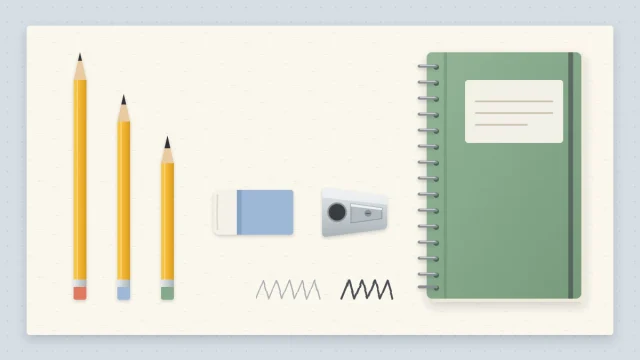
What you need
- HB pencil
- 2B pencil (optional)
- Plain paper
- Sharpener
- A small object from your desk
Random doodling is pleasant, but it tends to repeat what your hand already knows. A short, fixed routine does more: it covers the same core skills every day, so each one gets regular attention. These beginner sketching exercises fit into about ten minutes and need only a pencil and a sheet of plain paper.
The routine has five blocks of roughly two minutes each: lines, ellipses, boxes, one contour sketch and a value scale. The times are suggestions, not rules. Use a timer if it helps you keep moving, and ignore it if it makes you tense.
Why ten minutes a day works
Hand control is built by repetition spread over many days. A short daily session reminds your arm of the movements before it has had time to forget them, and it is small enough to do even on a busy day. One long session a week leaves six days for the skill to fade, and the final hour of it is often tired, heavy-handed work.
Ten minutes also lowers the stakes. Nobody expects a warm-up page to be beautiful, so you can concentrate on the movement instead of the result.
Before you begin
Use an HB pencil with a reasonably sharp point and any plain paper. Sit so your whole forearm can move freely, and hold the pencil a little farther back than you would for writing. Draw lightly throughout. Do not erase during the warm-up: the wobbly marks are useful information.
The ten-minute routine
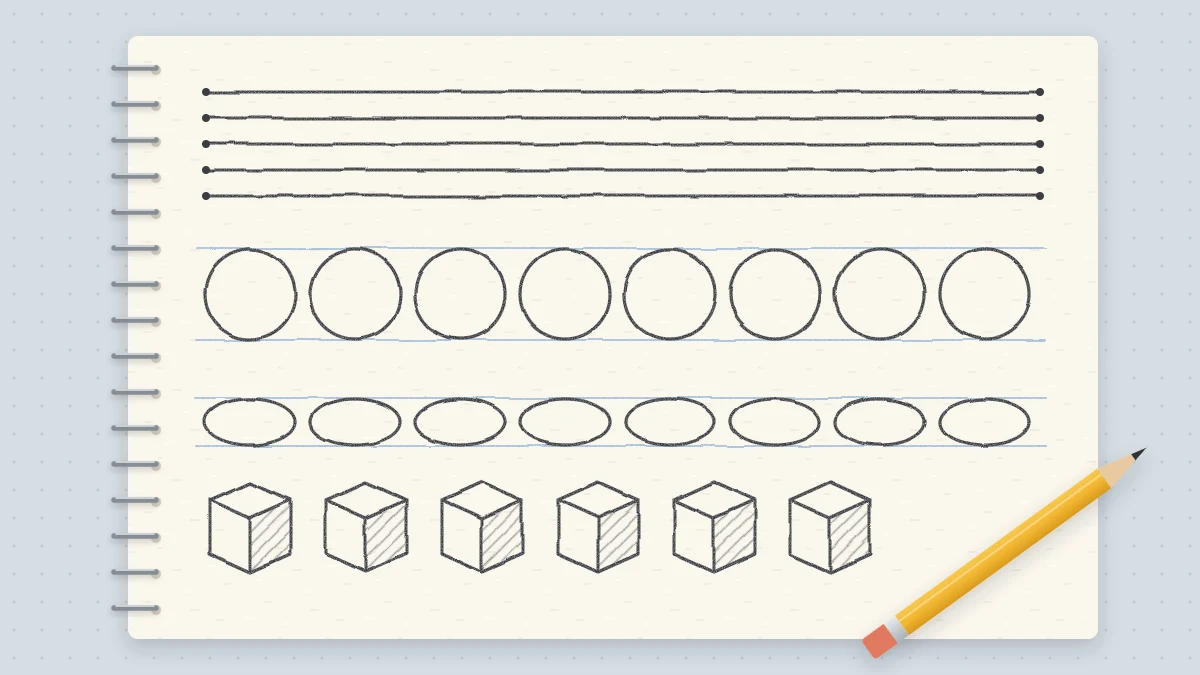
- Straight lines between two dots (about 2 minutes). Place two dots roughly 3 in (8 cm) apart. Hover the pencil and rehearse the path once, then join the dots in a single stroke. Repeat with new pairs of dots at different angles: horizontal, vertical and diagonal. Aim to finish on the second dot without slowing down.
- A row of circles and ellipses (about 2 minutes). Draw a row of circles, each about 1 in (2.5 cm) across, going around twice without lifting the pencil. On the next row, squash them into ellipses, the shape of a circle seen at an angle. Make some wide and some narrow. Keep the ends rounded, never pointed.
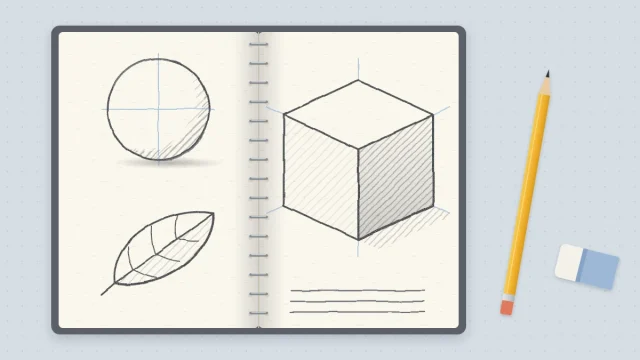
- A page of boxes (about 2 minutes). Draw small squares and rectangles freehand, checking that opposite sides stay parallel. When that feels comfortable, turn a few into simple three-dimensional boxes by adding a top and one side.
- One contour sketch (about 2 minutes). Pick a single object on your desk, such as a key, and draw its outline in one slow line, lifting the pencil as little as possible. Look at the object far more than at your paper.
- A five-step value scale (about 2 minutes). Draw five small squares in a row. Leave the first white, fill the last as dark as your pencil comfortably goes, and shade the three between so each step is evenly darker than the one before.

Notes on each block
Lines, ellipses and boxes
These three blocks train the strokes that every sketch is made of. For straight lines, turn the paper so the stroke runs in the direction your arm finds easiest. If your lines arc, you are probably pivoting from the wrist; move from the elbow instead. There is a fuller set of drills in the guide to line control exercises when you want more variety.
If an ellipse looks like a football with pointed ends, slow down at the turns and think of a running track. For boxes, compare the two vertical sides: they should stay upright and match in length. The article on drawing basic shapes explains how these simple forms combine into real subjects.
The contour sketch
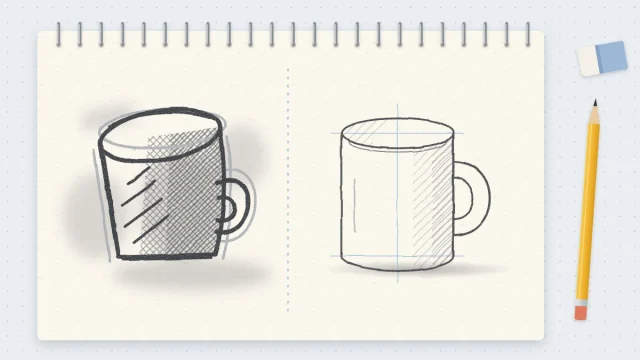
A contour drawing follows the edges of an object with a slow, continuous line. It is not meant to look polished. Its purpose is to make your eye travel along the real edge instead of guessing, which is the heart of contour drawing as a practice method.
Move your pencil at the same speed as your eye. When the edge turns a corner, your line turns too. The result will be a little distorted, with one part too long or a loop that does not quite close. That is expected.

The value scale
Value means how light or dark a tone is. Build each square with light layers of strokes instead of pressing hard at once. Check the scale by squinting: the five steps should look evenly spaced, with no two squares nearly the same. Most people find the middle step hardest, since it tends to drift toward one neighbor.
Tip
Proportion check for the scale: the middle square should look about halfway between the white of the paper and your darkest square. If it does not, adjust it before the others.
Keeping a practice page
Use one sheet per day and divide it loosely into five areas, one per block. Write the date in a corner. Keep the sheets in a folder or use the back pages of a sketchbook, in order.
Every week or two, lay the first page beside the latest. Look for specific changes: lines that reach their dot, ellipses that close cleanly, value steps that are more even. Progress in drawing is gradual and easy to miss from one day to the next, so the dated pages are your evidence.
Making the routine harder over time
When a block starts to feel automatic, raise the difficulty a little instead of adding minutes.
- Lines: move the dots farther apart, up to about 6 in (15 cm), or draw sets of parallel lines with even gaps.
- Ellipses: draw them inside boxes, or stack three of different widths along one center line.
- Boxes: draw them at different tilts, or lightly add the hidden back edges.
- Contour: choose a more complex object, or try a version without looking at the paper at all.
- Value scale: extend it to seven steps, or make one scale with hatching and another with smooth tone.
What to draw after the warm-up
The warm-up prepares your hand; a real sketch puts the skills together. If you have another ten minutes, pick a simple object and block it in with the same shapes you just practiced. A list of easy things to draw will save you from spending the time deciding.
Frequently asked questions
How often should I do sketching warm-ups?
Most days is ideal, because short and frequent practice keeps the movements fresh. Missing a day is not a setback; simply pick the routine up again. If you plan a longer drawing session, the same warm-up makes a good opening before you move to a real subject.
Should I use an eraser during practice drills?
It is better to leave the eraser alone. Wobbly lines and lopsided ellipses show you what to adjust on the next attempt, and stopping to erase breaks the rhythm. Draw lightly, repeat the mark beside the faulty one, and let the page fill up with honest tries.
What if I get bored doing the same exercises every day?
Keep the five blocks but change the details. Pick a new object for the contour sketch, draw lines at new angles, vary the width of your ellipses or add steps to the value scale. Small changes keep the routine interesting while the core skills still get daily attention.